Imitation Pearls for the Virgin Statue
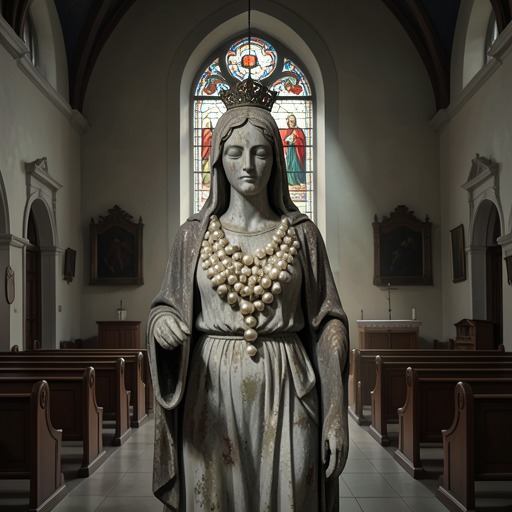
La piel del tamborThe Imitation Pearls for the Virgin Statue are twenty counterfeit replacements for the pearls once set into the Virgin’s face, mantle, and crown at Nuestra Señora de las Lágrimas. Their substitution makes a sacred image part of a material crime: the apparent value of the missing originals offers a possible source of restoration funds, while one false pearl in Honorato Bonafé’s pocket becomes a clue in the inquiry into his death. For Lorenzo Quart, however, the damaged imitation is more than evidence. It becomes the point where the investigation’s uncertain facts meet the church’s threatened existence and Príamo Ferro’s burden of guilt.
The Substitution
The Virgin’s image had twenty pearls arranged across its face, mantle, and crown. By the time police examined the church after Bonafé’s death, all twenty had been replaced months earlier by identical imitations. The operation was not immediately established as fact: the police investigation had taken the rest of the afternoon and part of the night, and its conclusions relied on reports, faxes, and the inquiries of officers following the jewels’ trail.
That trail pointed toward Francisco Montegrifo, a Madrid art dealer who had previously been the contact for Ferro in the irregular sale of the Cillas altarpiece ten years before. Montegrifo had put the pearls of Captain Xaloc into circulation, according to the investigation. Their description matched a batch detected in the hands of a Catalan jeweler who was a police informant and specialized in laundering illegally acquired goods. The evidence suggested Montegrifo’s mediation, but did not establish it: nothing, the investigators acknowledged, could yet be proved against him.
Money and the Church
The suspected proceeds gained significance against the parish’s financial circumstances. Nuestra Señora de las Lágrimas was in need of money to continue its restoration; Ferro’s stipend was small, and the Sunday collection could not even pay for the altar candles. The sum apparently associated with the pearls seemed to correspond with a resumption of construction work, including purchases of building materials and the rental of machinery. Suppliers contacted by Simeón Navajo’s men said that the cost of those deliveries exceeded what the priest’s pay and the church’s offerings could cover.
The building’s survival was already bound to a separate, old obligation. Under the 1687 privilege, the church was to retain its rights so long as Mass was celebrated each Thursday for the soul of Gaspar Bruner de Lebrija, its benefactor. Macarena explains that the Mass is held at eight in the morning, on the day of Gaspar’s death in 1709. Each Thursday, an archbishop’s representative and a notary paid by Pencho Gavira watch for a missed service or any other irregularity that might leave the church vulnerable to demolition. The counterfeit pearls thus enter a struggle in which both sacred objects and religious observance have practical consequences for the church’s precarious future.
Bonafé’s Pearl and the Murder Inquiry
After Bonafé is found dead, Navajo shows Quart a small nacre-colored ball in a plastic bag. The priest had surprised the journalist on scaffolding at the main altar; Bonafé had the pearl in his jacket pocket. Navajo confirms that it is one of the Virgin’s twenty pearls, then delivers the crucial qualification: it is false, like the other nineteen.
The single pearl provides the investigators with a possible motive and a sequence of conjectures, not a demonstrated account of the killing. Navajo reasons that Bonafé may have been following the substitution, gone to the church, and confirmed that the pearls were imitations. He may then have tried to blackmail Ferro—or the priest may have surprised him before any such attempt—before killing him. The police imagine the sacristy door being locked afterward, followed by Ferro spending a couple of hours in the tower of Casa del Postigo and then disappearing for a day. Navajo’s reconstruction gives the false pearl evidentiary force, but its conditional language leaves room between what the investigation can establish and what it can only infer.
The Damaged Object and Its Meaning
Quart studies the bagged pearl without touching it. Its coating is thick and peeling where it had been attached in the image’s setting: it is not merely a counterfeit identified by comparison, but a worn object that has been detached from the place that gave it religious and visual meaning. In Bonafé’s pocket, it seems to carry the quality of a deadly object. The same imitation that might expose the pearl substitution also draws the dead journalist into a mystery Quart feels cannot be contained by police procedure alone.
The image’s pearls stand at the intersection of resemblance and difference. The imitations were made to look identical to the originals, yet their identity as copies changes what they signify: in the Virgin’s setting they had passed as part of the sacred image; removed and examined, one becomes evidence of concealment, possible financing, and a death. The distinction is not visible as simple appearance. It emerges through the investigation, the damaged surface, and the object’s new place in Bonafé’s pocket.
For Quart, the pearl finally helps the elements of the case fall into a wider pattern: the imitation, the church, and the city belong together in a moment of fragile shelter and approaching loss. His understanding shifts away from treating the object only as a clue to a possible killer. The pearl’s removal from the Virgin’s image raises the danger of profaning a place that offers refuge to those seeking consolation, while the suspected killer’s identity remains unresolved in Quart’s reflection. The object becomes the material hinge between a criminal question and a moral one: who, in defending or burdening the church, will carry the consequences of its threatened sanctuary?